Open the door fully. Let go. Say nothing and watch.
It should swing back, slow near the end, and click onto the latch without any help. If it doesn't, your door is relying on somebody remembering to shut it during a fire.
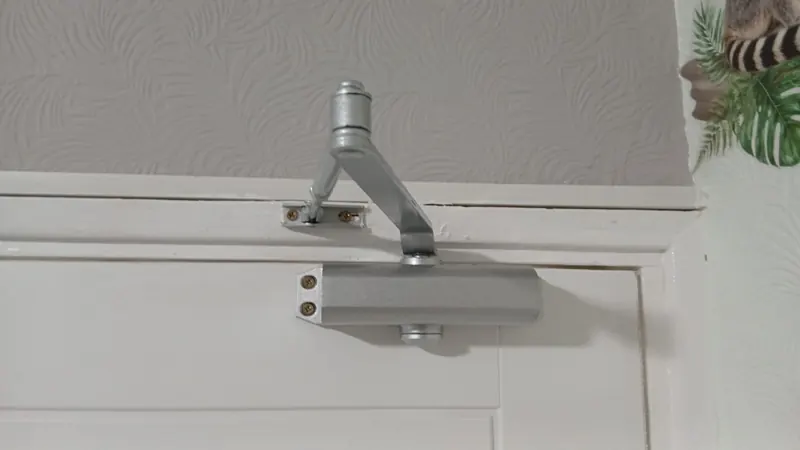
Why people take closers off
Nobody disables one for fun.
A closer set too strong will knock an elderly resident off balance, or trap the fingers of a child. Tenants carrying shopping get fed up. So an arm gets unhooked, and the door then stays open for years.
Before replacing a closer that someone has removed, we ask why they did it. If the real complaint is weight, a new unit set the same way will be off the wall again by Christmas.
Adjust, repair or replace
Plenty of closers need nothing more than a quarter turn of two valves. One controls the sweep, the other the last few degrees before latching. We start there, as it costs next to nothing.
A unit leaking oil is finished. Look for a dark streak on the door face below it.
Stripped fixings are a separate problem. The screws have pulled out of the door top, and simply putting longer ones in the same holes won't last. We repair the fixing point so that the closer has solid material to bite into.
Replacement closers need to suit the door. Fire doors call for a unit tested to BS EN 1154 and marked for that use, sized to the weight and width of the leaf. A heavy hotel bedroom door and a light cupboard door are different animals.
Doors that catch before they close
A surprising number of closer faults have nothing to do with the closer.
Often the hinge has dropped and the bottom edge drags on the carpet. New carpet does it. A thicker underlay goes down and last year's door won't shut.
We sort the actual cause. Fitting a stronger closer to overpower a binding door just moves the problem onto the hinges.
Hold-open devices
Some corridors use a device that holds the door open and lets go when the alarm sounds. It is wired to the fire alarm, so an alarm engineer has to be involved. Tell us if you have one.
Flats and rented rooms
A flat entrance door opening on to a shared corridor or stair should normally have a closer. A bedroom door in a licensed HMO often needs one as well, depending on what your council and your fire risk assessment say.
We carry closers for both.
Send it to us with the postcode and we will price it door by door.
Get a price